
{“focus_keyphrase”:”resistance band workout”,”secondary_terms”:[“resistance bands”,”band exercises”,”light resistance”,”full-body routine”,”band anchor”,”sets and reps”,”proper form”,”band safety”],”seo_title”:”Resistance Band Workout for Beginners — Full Plan”,”meta_description”:”Start a safe resistance band workout for beginners with a 20–30 minute full-body routine, equipment advice, form tips and simple progressions you can do at home.”,”slug”:”resistance-band-workout-beginners”,”excerpt”:”A practical beginner’s guide to resistance band workouts: what bands to buy, a 20‑minute full‑body routine with reps and progressions, safety tips, and warm-up and recovery advice.”,”featured_alt”:”person performing resistance band squat in a living room”,”visual_anchors”:[“loop resistance band on mat”,”person doing band squat”,”band anchored to a closed door”,”band with handles in hand”,”beginner performing seated band rows”,”exercise mat and water bottle”,”small stack of resistance bands showing different thicknesses”,”band anchor strap looped around door”],”image_plan”:[{“query”:”woman doing resistance band squat in living room”,”alt”:”woman performing resistance band squat with loop band”,”section_hint”:”opening routine demonstration”},{“query”:”resistance bands and handles on exercise mat”,”alt”:”set of resistance bands with handles laid out on a mat”,”section_hint”:”choosing bands and equipment guidance”},{“query”:”person anchoring resistance band to door and performing row”,”alt”:”person using a door anchor to do a band row”,”section_hint”:”how to anchor bands safely”}]}
A quick scene you know: no gym, 20 minutes, and some resistance bands
You walk in from work with twenty minutes and no time for the gym. You own a set of bands, but you’re unsure how to use them without injury or wasting time. A resistance band workout can give you an efficient, full‑body session in a small space—no heavy equipment required.
Short answer: do a 20–30 minute, 6‑exercise routine that covers hinge, squat, push, pull, lunge and core. Use light to medium bands at first, focus on slow, controlled movement, and progress by adding tension, reps, or another set. Below is a practical plan, how to choose bands, safety tips and progressions you can actually use today.
What you need and how to choose the right bands
Minimal gear: a set of loop or tube resistance bands, a door anchor (or sturdy post), and a mat. Bands come in different formats—flat loops, tubes with handles, and long therapy bands. For most beginners a set that includes at least three resistance levels (light, medium, heavy) covers progressions.
When to pick each type: loop bands are compact and great for lower‑body and core work; tube bands with handles feel closer to dumbbells for pressing and rowing. If you’ll train at home and want versatility, a pack with varying resistances and a door anchor is the sensible first buy. See available options in our Resistance Bands category.
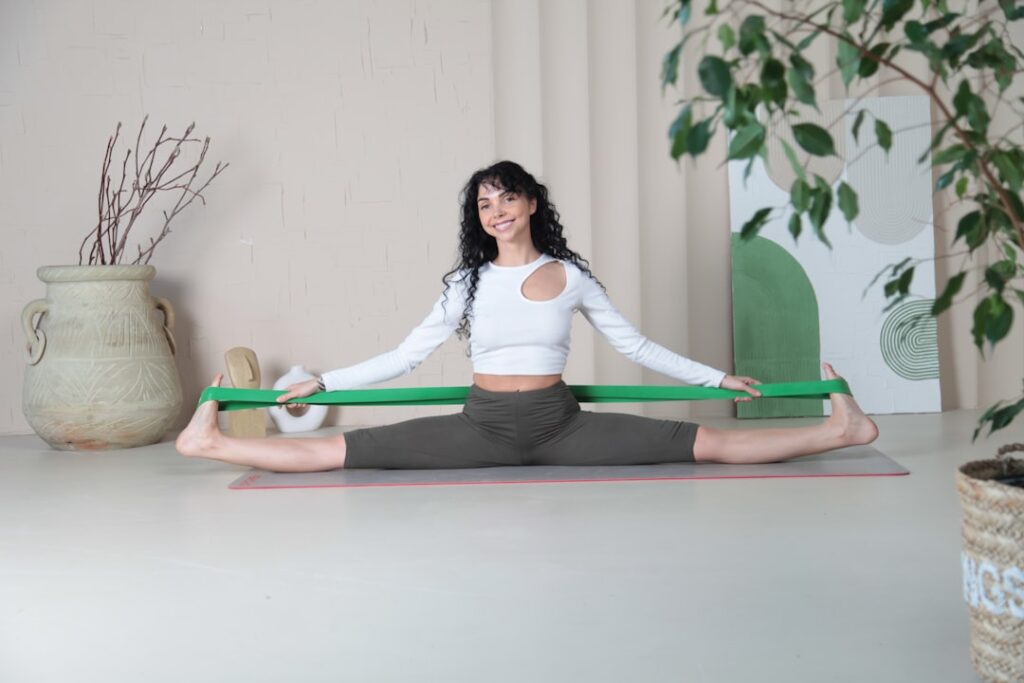
A simple resistance band workout for beginners (20–30 minutes)
Do this circuit 2–3 times, resting 60–90 seconds between rounds. Aim for 8–15 reps per exercise depending on band tension—choose a band that makes the last 2–3 reps challenging but doable with good form.
- Banded squat — 10–15 reps. Stand on a loop or step on a tube, feet shoulder‑width, band at shoulders or held in handles. Sit back into hips, chest up. Builds quads and glutes.
- Standing band row — 10–12 reps. Anchor band at mid‑chest height (door anchor or post). Hinge slightly, pull elbows back squeezing shoulder blades. Builds mid‑back and posture muscles.
- Chest press — 8–12 reps. Anchor behind you at chest height, press handles forward at shoulder level. Keep a neutral spine; think of pushing through palms.
- Banded Romanian deadlift (RDL) — 10–12 reps. Stand on band, hold handles or a loop with both hands, hinge at hips with a soft bend in knees. Targets hamstrings and glutes.
- Reverse lunge with band — 8–10 reps per leg. Step back into a lunge while holding band under front foot or across shoulders. Focus on steady control on the way up.
- Dead bug with light band or Pallof press — 10–15 reps per side. Anti‑rotation core work—anchor band to side, hold tension and press arms away. Good core stability transfer.
Tempo tip: 2 seconds lowering, 1 second pause, 1 second lifting. Control reduces momentum and increases muscle engagement.
Form cues, common mistakes and band safety
- Inspect bands before each session—look for tears, thinning, or sticky residue. Replace if damaged.
- Anchor securely. A door anchor should be on the hinge side for safety and the door fully closed and locked if possible.
- Maintain joint alignment—knees tracking over toes, neutral spine, and avoid rounded shoulders during rows and presses.
- Avoid snapping bands back—control both concentric and eccentric phases. Bands store elastic energy; sudden release can hurt skin or eyes.
How to progress after the first 4–6 weeks
If the routine becomes easy, progress with one of these options: increase the band tension (move from light to medium), add an extra set, increase reps by 2–4 per exercise, slow the eccentric phase, or pair exercises into supersets to raise intensity. Rotate exercises—replace the RDL with single‑leg RDLs, or chest press with incline chest press using a higher anchor—to keep stimulus novel.
Frequency, recovery and where resistance bands fit in a fitness plan
For general strength and fitness, aim for 2–3 resistance band sessions per week with at least one rest or mobility day between sessions. Bands are excellent for building baseline strength and mobility; if you want to advance to heavier loads later, combine bands with occasional dumbbell or bodyweight strength sessions. For guidance about building a broader strength routine at home, see our Beginner Strength Training at Home guide.
Finish sessions with light stretching and a short mobility flow for hips and shoulders. If you train hard, consider a simple recovery tool like a massage gun or foam roller—see recovery options in our Workout Recovery Equipment category.
Wrap-up: make resistance band workouts an easy habit
Resistance band workouts are portable, adaptable and effective for beginners when you choose the right tension, prioritize safe anchors and clean movement patterns, and follow a short, repeatable routine. Start with 20–30 minutes, twice a week, and dial up volume or resistance as your strength improves.
- Inspect bands for tears and choose a light/medium option for your first session.
- Set up a secure anchor (door anchor or sturdy post) before starting.
- Warm up 5–8 minutes with dynamic moves (leg swings, arm circles, hip hinges).
- Follow the 6‑exercise routine and stop if you feel sharp pain or band failure.
- Record the band strength and reps so you can track progression next session.
A short, structured resistance band workout can deliver full‑body strength gains without a gym. Begin with light to medium bands, emphasize slow controlled reps and steady progression, and use secure anchors and routine notes to increase intensity safely.
How often should a beginner do resistance band workouts?
2–3 times per week is a good starting point, allowing at least one rest day between sessions for recovery.
Which resistance bands are best for beginners?
A set that includes light, medium and heavy resistances—either loop bands or tubes with handles—gives flexibility across exercises and progression needs.
Can resistance bands build real strength?
Yes. Bands provide progressive resistance and, when combined with proper tension and progressive overload, they effectively build strength and muscle for most beginners.
How do I know when to switch to a heavier band?
If you can complete all sets with perfect form and the last 2–3 reps feel easy, increase resistance or add another set to continue progressing.
Are bands safe for older beginners or those with joint issues?
Bands are low‑impact and often easier on joints than heavy weights, but start light, focus on controlled motion, and consult a professional if you have existing joint conditions.